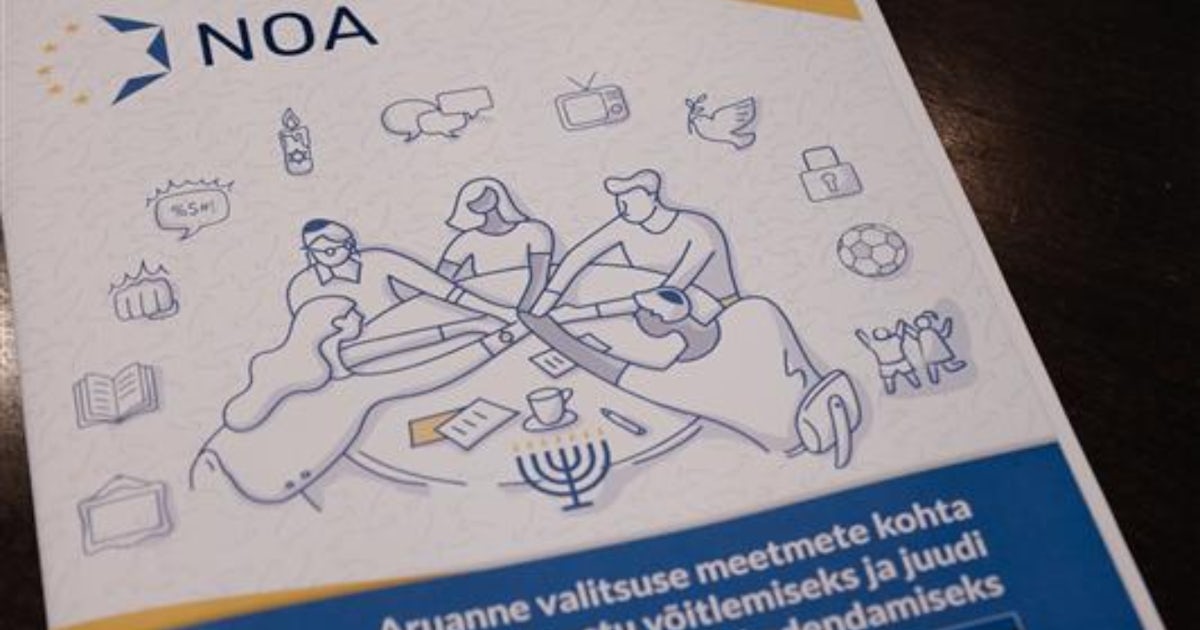
ESTONIA – The Networks Overcoming Antisemitism (NOA) initiative, co-funded by the European Union, presented its National Report Cards on Estonia on Tuesday. The event was held in partnership with the World Jewish Congress (WJC), the European Union of Jewish Students (EUJS), the European Association for the Preservation and Promotion of Jewish Culture and Heritage (AEPJ), CEJI – A Jewish Contribution to an Inclusive Europe, and the Jewish Community of Estonia.
The conference brought
together government officials, policymakers, and Jewish community
representatives in Tallinn, where they were presented the findings of the
Estonian National Report Card (NRC). The NRCs provide a nuanced holistic
snapshot of EU Member States’ policies to combat antisemitism and foster Jewish
life. They serve as substantial resources and benchmarking tools, helping
Member States to develop and implement national action plans to combat antisemitism
and foster Jewish life.
The conference began with
opening remarks from Igor Taro, Minister of the Interior of Estonia, Vitaly
Pishchanok, Chairman of the Board of the Jewish Community of Estonia, Pascale
Falek, Policy Officer from the Office of the European Commission
Coordinator on combating antisemitism and fostering Jewish life, and Estelle Cincinatis, NOA Project
Coordinator.
WJC Director of European
Affairs Dany Levin Prist led a panel discussion focusing on the
multifaceted reality of Jewish life in Estonia. The conversation examined key
themes including human rights, religious tolerance, political participation,
and the everyday experiences of Estonia’s small yet dynamic Jewish community.
During the panel, Ringo Ringvee from the Estonian Ministry of the
Interior provided insights from the government’s perspective, while Alla
Jakobson, Member of the Council of the Jewish Community of Estonia, shared
her decades of experience as a Jewish advocate in the country. Professor
Mart Rannut, Board Member of the Estonian Institute of Human Rights,
contributed to the discussion from a human rights standpoint.
In the afternoon panel
discussion titled Shared Spaces: Jewish and Estonian Youth in Dialogue, panelists
discussed the realities facing Estonian youth in public education, civic life,
and public participation. Moderated by Jonas Markowitz, Executive
Director of the European Union of Jewish Students, the conversation brought
together Mark Dorfmann, Jewish Educator at JCC Tallinn; Rudolf Kasper
Naruski, President of the Estonian Union of Jewish Students; and Darja
Shklovskaja, Member of the Tallinn City Youth Council. Together, they
explored what it means to be young and Jewish in today’s Estonia, reflecting on
the challenges faced by minority youth, the importance of coalition-building
and bridge-building, and the creation of shared spaces that foster inclusion,
understanding, and mutual support across communities.
La source de cet article se trouve sur ce site