NEW YORK – The World Jewish Congress, in partnership
with the Consulate General of the Czech Republic in New York, held a high-level
event on Tuesday bringing together diplomatic leaders and young Jewish
professionals for an in-depth discussion on how Jews can live openly and fully in democratic societies while confronting antisemitism, violence, and exclusion from public life and highlighting what enables Jewish life to endure and thrive. The gathering took place as antisemitism continues to surge globally and across
the New York metropolitan area at a startling rate.
In opening remarks, Karel Smékal, Consul General of
the Czech Republic in New York highlighted his country’s firm commitment to
combating antisemitism, stating “we all must work tirelessly not to give way to
antisemitism in any form or shape.” Reaffirming the Consul General’s assertion
that there needs to be a collective effort against the challenges facing Jewish
communities, WJC’s Head of the Executive Office, Lauren Rose, reflected
on growing up in Europe, where it is a “reality in many places that security is
ever-present around Jewish institutions and Jewish life.” Rose noted that “What
has been unsettling over the past period is seeing some of the same reflexes
begin to surface here as well, including in New York,” adding, “Representation is not an abstract idea. It is
how you press institutions to take responsibility, and how you defend the space
for Jewish life to remain present in public.”
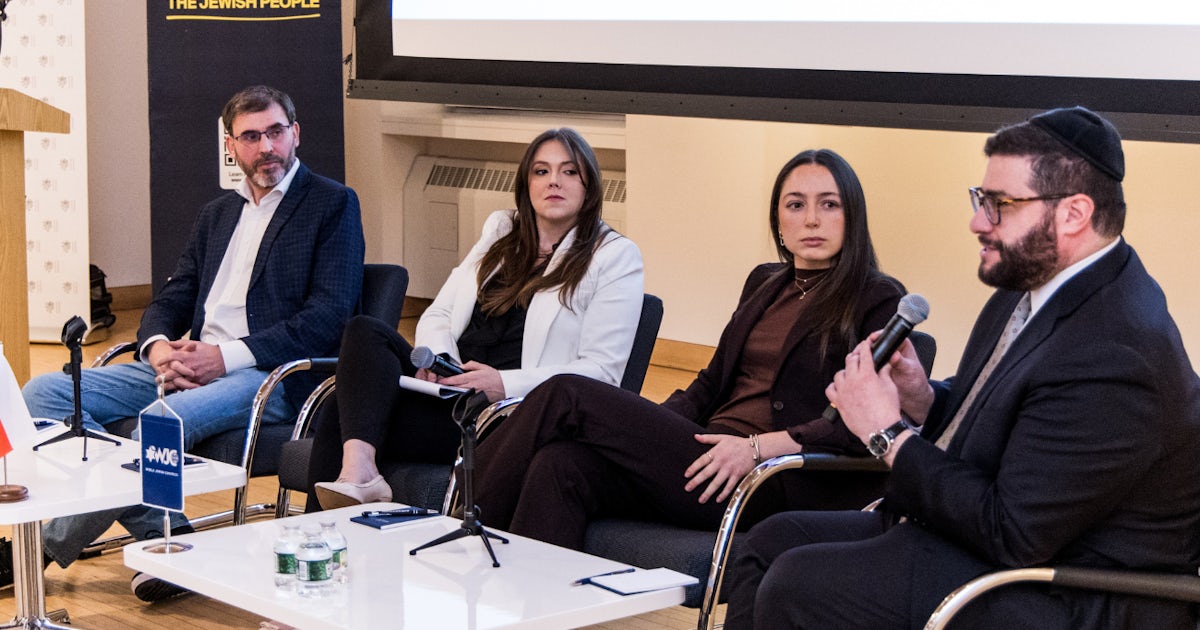
Members of the panel discussion, moderated by WJC Executive
Committee member Elizabeth Chen, included Petr Papoušek, president
of the Federation of Jewish Communities in the Czech Republic and a World
Jewish Congress Vice President, Rabbi Benjamin Goldschmidt, founder of The
Altneu Synagogue in New York, and Bella Ingber, a WJC Jewish Diplomatic
Academy member and graduate of New York University.
Each spoke from a
unique perspective on how Jewish communities, communal institutions, and
government bodies are addressing the rise in antisemitism and growing security
threats, including through the encouragement and implementation of national
strategies to combat anti-Jewish hatred and increase public awareness
surrounding key issues.
Key Insights:
-
Elizabeth Chen, WJC Executive Committee member, opened the discussion on
advancing Jewish life in the public sphere through formal policies such as the
IHRA working definition of antisemitism, which she said has set a gold standard
for antisemitism measures. Chen also spoke to Jewish resilience, noting
that it often requires courage, explaining “it’s not about the absence of fear.
It’s about the courage to do something about it, to be the one who knows what
to do, to protect those you love. Fear is important. But the resilience portion
of it is even more important.” - Petr Papoušek, president of the Federation of Jewish Communities in the Czech Republic, spoke of the strong relationship between the Czech government and its Jewish community, emphasizing their joint efforts to ensure a safe and secure environment for Jewish life in the public sphere and how they cooperate to promote a safe environment for Jewish life to exist in public. Papoušek highlighted the government’s implementation of a national strategy to combat antisemitism plan for 2025–2030, which serves as a mechanism to address the current reality facing Czech Jewry today. Papousek noted that the national strategy reflects a collective trend amongst European governments towards cooperating with Jewish communities, stating “once the state is putting such a material forward, it means that they understand that there is a problem.”
- Rabbi Benjamin Goldschmidt, founder of New York’s Altneu Synagogue, shared how his synagogue nurtures vibrant Jewish life in despite social and security-related challenges. Speaking on his personal experiences with antisemitism, Rabbi Goldschmidt highlighted that responding to antisemitism with pride in Jewish traditions, rather than fear or trauma, strengthens Jewish identity and community resilience. “There’s a lot of bad actors in the world. But we tend to forget there are a lot of good ones too,” he said. “And we need to focus on strengthening relationships with people, communities, and faiths, who care about many of our similar values, who do not like extremism and hatred.
- Bella Ingber, a WJC Jewish Diplomatic Academy member, explained what shaped her into becoming a student advocate after taking direct legal action against New York University for the anti-Jewish hatred that she and her fellow Jewish classmates reported on campus since October 7th. Ingber encouraged Jewish students to “fill in those attitudes that government can’t control” when it comes to protecting their legal rights, explaining, “we need to be literate in our rights in what we need to not only expect, but what we deserve from our administrations on campuses and also from law enforcement as well.”
The panel closed with a Q&A session with members of the
audience.
La source de cet article se trouve sur ce site