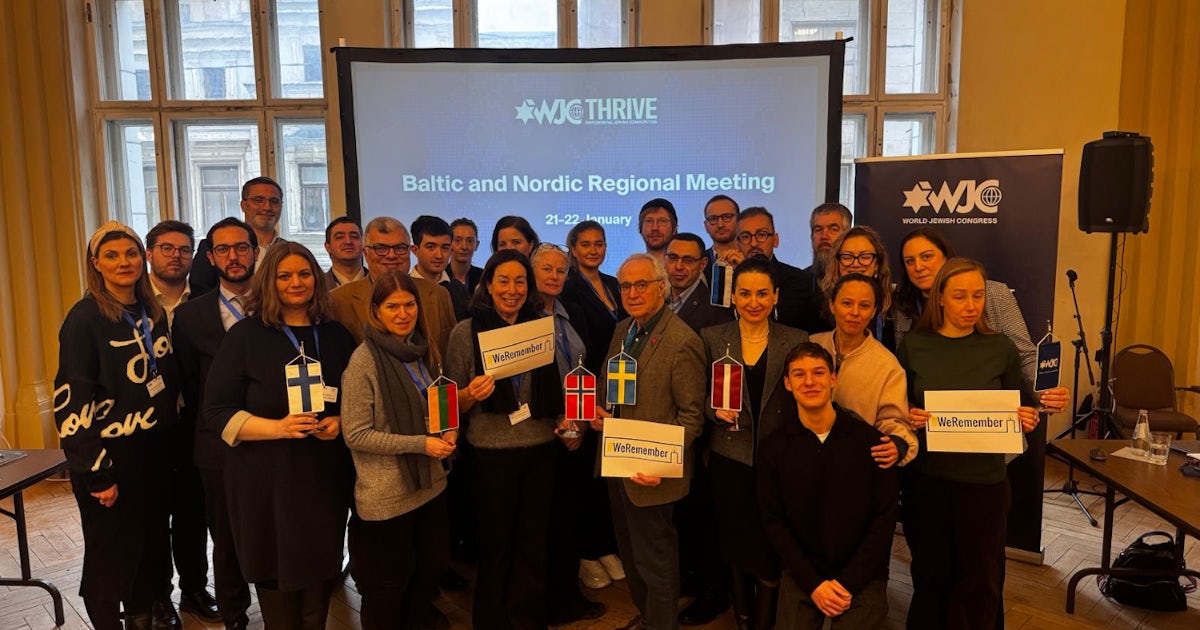
RIGA – The
World Jewish Congress (WJC), through its Thrive Project, in partnership
with the Latvian Jewish Community convened a Baltic-Nordic Regional Meeting
in Riga on 21–22 January, bringing together Jewish community leaders from Estonia,
Latvia, Lithuania, Sweden, Denmark, Norway, and Finland.
The meeting provided a structured framework
for engagement between Nordic and Baltic Jewish communities, enabling
participants to assess shared challenges and explore avenues for strengthened
regional cooperation.
Over the two days, participants examined
the evolving realities of Jewish communal life in the region, reflecting on
demographic change, community structures, and the ways communities respond to
shifting social and security environments. The discussions allowed community
leaders to share experiences and assess how existing models adapt to
contemporary needs.
Key discussions focused on internal
community dynamics, including membership frameworks, engagement strategies, and
programme development. Participants explored approaches to inclusion, identity,
and sustainability, as well as methods for ensuring that community life remains
relevant and accessible to both members and those who engage outside formal
structures.
The meeting also addressed cooperation with
public authorities and institutional partners, with exchanges on building
effective relationships with governments and security services. These
discussions examined practical approaches to safeguarding Jewish life,
countering antisemitism, and responding to security challenges facing
communities across the region.
Youth engagement was another central theme,
with dedicated discussions on strengthening young people’s involvement in
communal life and creating pathways for greater responsibility. Participants
emphasized the importance of intergenerational dialogue and the role of younger
generations in shaping the future of Jewish communities.
Reflecting on the meeting, Viktorija
Jusė, Jewish Community Liaison for the Nordic, Baltic, and Eastern European
regions at the World Jewish Congress, underscored the importance of
community-driven engagement:
“For the World Jewish Congress, it is
essential to remain closely connected to the realities our communities face.
Meetings such as this help us better understand how to support communities
across multiple levels — from combating antisemitism and engaging with
policymakers to strengthening resilience and sustaining vibrant Jewish life. I
hope this gathering will continue to serve as a lasting platform for regional
cooperation.”
Mila Stojanović, Community Liaison for the Balkan region and Events Manager at WJC,
highlighted the value of regional exchange:
“Regional dialogue allows communities to
learn from one another in a practical and honest way. While national contexts
differ, many of the challenges are shared, and cooperation across regions helps
identify solutions that are both realistic and sustainable.”
The Thrive Project, funded by the European Commission and implemented by World Jewish
Congress (WJC) in cooperation with European Union of Jewish Students (EUJS) and
the European Association for the Preservation and Promotion of Jewish Culture
and Heritage (AEPJ), aims to reinforce Jewish life in Europe through practical
cooperation and sustained community dialogue.
La source de cet article se trouve sur ce site