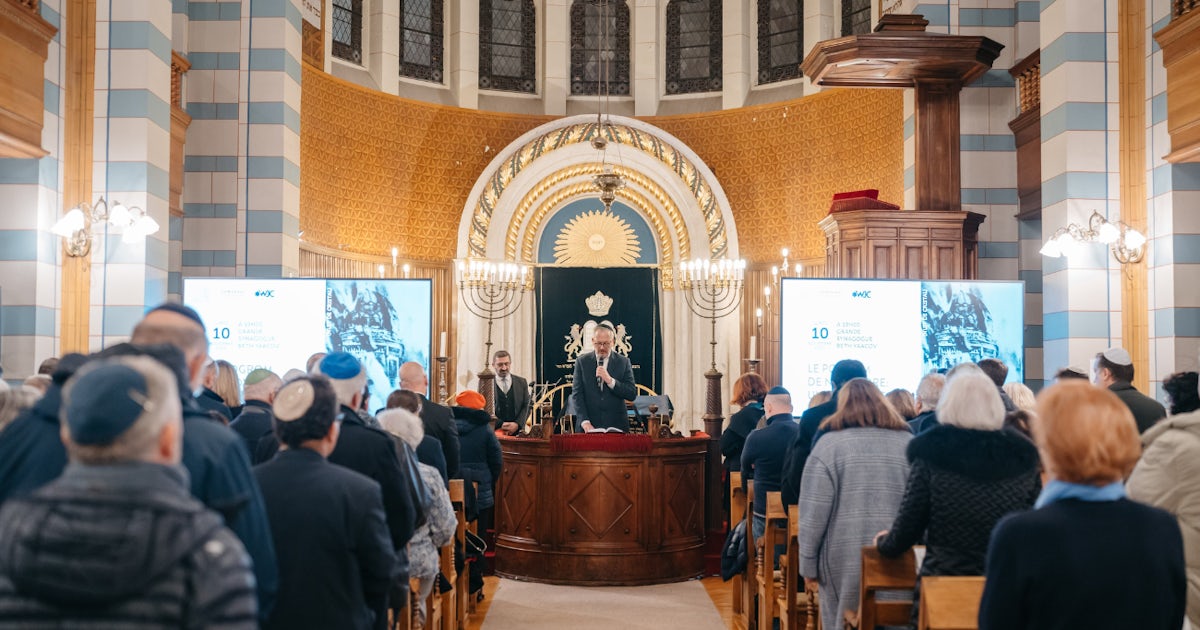
GENEVA – The historic Beth Yaacov Synagogue hosted a commemoration on Monday
evening, 10 November, marking the anniversary of the November Pogrom of 9–10
November 1938. Known as Kristallnacht, it marked a decisive escalation in Nazi
Germany’s campaign against the Jews: hundreds were killed, synagogues and
businesses were destroyed, and more than 30,000 Jewish men were arrested and
deported to the first concentration camps. The event was organized by the World
Jewish Congress and the Jewish Community of Geneva, with the support of the
Gamaraal Foundation, and brought together more than 150 participants, including
around 20 ambassadors and other representatives of UN member states.
Moderated by WJC’s International Relations Officer Damon
Biesold, the evening began with opening remarks from Mrs. Roseline
Cisier, president of the Jewish Community of Geneva.
Ambassador Antje Leendertse, German Permanent
Representative to the UN, reflected on the historic devastation Germany
embodies since the November Pogrom. Eighty-seven years later, she noted, German
Jewry still fear expressing their identities, especially after the October 7 terror
attacks in Israel. But symbolic gestures like the reopening of a synagogue on
Reichenbachstraße in Munich — one of the world’s very few Bauhaus synagogues
destroyed in 1938 — demonstrate that there is still a vibrant Jewish life in
Germany today. The November Pogrom, Amb. Leendertse said, continues to demand
“awareness, courage, and a clear voice of responsibility in Germany today.”
Delivering opening remarks, Ambassador Daniel Meron, Israeli
Permanent Representative to the UN and, whose country serves as Chair of the
IHRA for the 2025-2026 term, drew a poignant connection between the ‘Night of
the Broken Glass’ and the surge of antisemitism in the modern era. Reflecting
on the Israeli IHRA Presidency motto “Crossroads of Generations,” Amb. Meron highlighted
how Kristallnacht truly began “when hateful propaganda became normal and
widespread” as mass communication was exploited by the Nazi Party so that “when
the time came for clear and unequivocal orders, those who accepted hatred in
their hearts could follow.”
He further warned that social media is weaponized
today to dehumanize and threaten the Jewish people worldwide, evident in the
burning of synagogues, the murder of innocent Israelis, and the attacks on
Jewish institutions across the world. Underscoring the power of reaching mass
audiences through speech, Ambassador Meron called on attendees to “ensure that
the shattered glass of 1938 does not echo in the shattered lives of 2025.
Also taking the floor, Ambassador Anna Ifkovits of
Switzerland spoke about her country’s
historical stance. She acknowledged Switzerland’s restrictive refugee policy
during that period and expressed regret for the human consequences that
resulted from it.
The program then
featured a lecture by historian Mr. Tal Bruttmann, “The November
Pogrom: A Turning Point,” which offered a clear analysis of the event’s
historical impact and broader context. Dr. Fabienne Regard complemented
his presentation by showcasing archival materials from the period preserved by
the Jewish Community of Geneva, offering an important link between local memory
and broader historical narratives. Works by N. Borenstein, E. Bloch, and J.
Achron were performed throughout the evening by violinist Mrs. Bianca Asséo.
La source de cet article se trouve sur ce site